
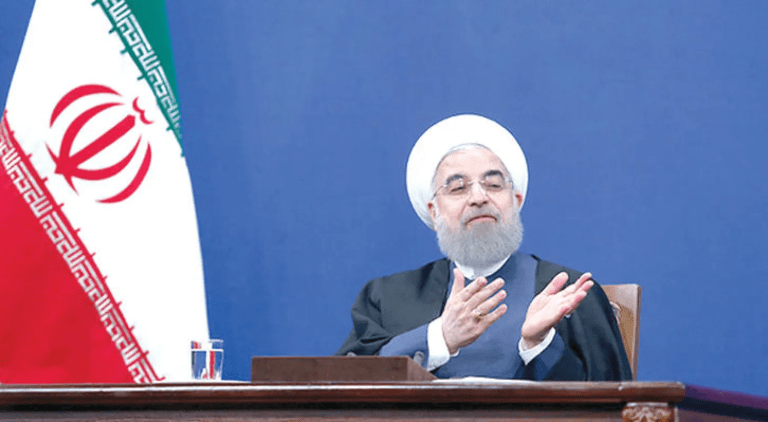
Former Iranian President Hassan Rouhani has called for the Iranian people to be consulted on whether the country should continue its military confrontation with major powers, stressing that any decision to sustain a war for decades should be based on the will of the public.
Rouhani made the remarks in newly released video recordings from a meeting held on August 31, 2026, with a number of governors, deputy governors and district governors who served during his two presidential terms. Additional excerpts from the meeting were released on Friday evening, September 4.
“If we are supposed to continue fighting the major powers of the world for another 20 years, we must first ask the people what they think,” Rouhani said.
“If the people say they accept it, then that is very good, and we should continue on that path. But if the people do not accept it and point us toward another path, should we not accept that?” he added.
The former president stressed that officials at all levels derive their legitimacy from the people, saying that “everyone who holds any position in this country, at whatever level, received that position as a trust from the people.”
He explained that no one governs solely by their own authority, arguing that the people have directly or indirectly voted and, through their votes, placed power and authority in the hands of individuals at various levels.
Rouhani Cites the Principle of Consultation
Rouhani also invoked the principle of consultation, referring to what he described as the Prophet Muhammad’s practice of seeking advice from others.
“The Prophet used to consult people,” Rouhani said, asking: “Are we not prepared to consult our own people? Those who entrusted us with this authority?”
His remarks appeared to underscore the importance of involving citizens in major decisions concerning Iran’s future and the continuation of the war.
Growing Calls in Iran for Talks With Washington
Rouhani’s comments come as calls grow within Iran for pursuing a negotiated path with the United States.
Iranian Parliament Speaker and head of the negotiating delegation with Washington, Mohammad Bagher Ghalibaf, as well as Iranian President Masoud Pezeshkian, have previously stressed the importance of negotiations with the United States.
On August 26, Pezeshkian called for an end to the war with Washington, saying that war is not always the solution and that issues that can be resolved through peaceful means should not be addressed through force.
The statements by Rouhani, Pezeshkian and Ghalibaf reflect an increasingly prominent debate inside Iran over how to deal with the United States and other major powers, and whether continuing the military confrontation remains the best option, amid growing emphasis on taking the public’s views into account on decisions that could determine the country’s future.