

Written by Hwaida Awad Ahmed
It is no secret across the entire planet that the Zionists are the ones who decide the war against Iran—when it begins, when it ends, and when we sit at the negotiating table.
It is the Third World War and an expansion of intertwined Zionist influence in the Middle East, alongside the Israeli dream of a “Greater Israel” stretching from the ocean to the Gulf. Implementation is proceeding at full speed: incursions into Syrian territory, renewed conflict with Hezbollah—one of Iran’s arms in the region—and, at the same time, the use of U.S. President Trump as the new king.
Yes, he has appointed himself the new king of the globe, who, with his vast armies, can turn all countries into subordinate emirates or new states governed by rulers under his command and control, as he allegedly did in Venezuela—removing its president, planting his own envoys, and seizing its oil.
After the Jews allegedly devised the plan for Trump and his armies, they pressured him following the Epstein file—an island said to have been created with Zionist money and ideas to preserve files and videos of many influential figures worldwide and use them when necessary to serve their interests.
This pushed forward a large-scale operation to strike Iran, occupy its lands, and take control of its oil and enriched uranium, using Gulf bases to attack Iran and forcing Gulf countries to provide more funds to pay for a war they never requested. This comes despite historical tensions between the Gulf and Iran, and despite Iran’s interventions, encroachments, and espionage across the Middle East—behavior described as similar to other colonial states with ambitions toward their neighbors’ resources.
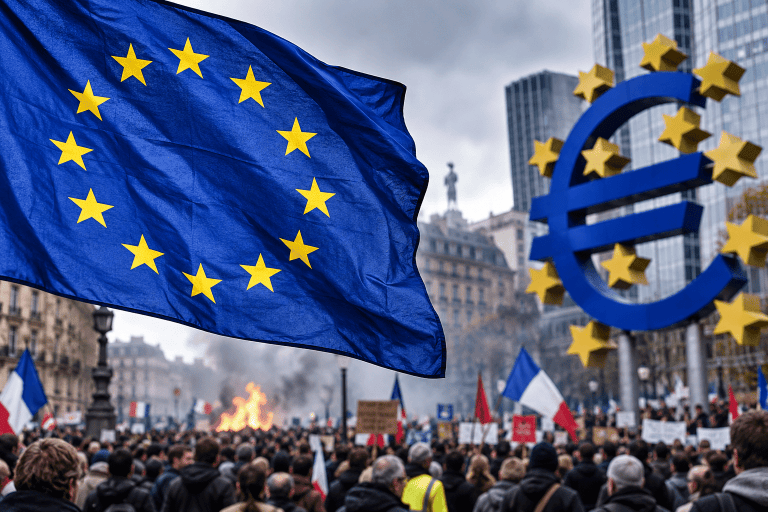
For more than a month, the war has been raging between the U.S.–Israel alliance on one side and Iran and its allies—China and Russia—on the other, even if this is not explicitly declared. More than eight million Americans have protested, chanting “No Kings,” including actors, influencers, and various segments of society, denouncing the war on Iran, immigration deportation agencies, and Trump’s policies. Arrest waves have reportedly targeted more than 4,000 demonstrators opposing what they see as dictatorship and imperial ambitions.
This contradicts the American system, in which the people are sovereign and the country is democratic and institutional. Yet Trump, according to this perspective, has disregarded all of that. He is portrayed as unconcerned with his people or economy, acting as a mere figurehead to carry out orders of the Israeli entity, the Zionist lobby, and powerful global elites operating behind the scenes to secure Israel and exploit nations’ resources.
The narrative portrays Netanyahu as another puppet—an arrogant figure mocking Arab leaders and declaring victory while the war continues. The intense anger toward Iran and Israeli intelligence operations allegedly aims to weaken Iran’s regime and encourage an uprising, presenting a “savior” to replace it with a ruler aligned with U.S. and Israeli interests.
Trump, described as a businessman focused on money, is said to be influenced by real estate interests, associates, and religious ideologies tied to prosperity theology and beliefs about the second coming of Jesus. From this religious angle, it claims Jews guide Trump to control the “Promised Land” and expand further.
Since the 2024 assassination attempt in Pennsylvania, when a bullet passed near his ear, Trump reportedly saw himself as chosen or saved by God—an idea said to be reflected in U.S. military rhetoric that soldiers are fighting under divine orders.
The clearing of the Strait of Hormuz—called “Trump Strait” in this narrative—is framed as controlling global shipping, oil, and trade. But the question arises: will Vietnam repeat itself? Could the war shift from a swift campaign to a long war of attrition, exhausting the U.S. without victory, while consuming old weapons stockpiles and simultaneously producing newer, more lethal arms?
Such a conflict could impoverish the Middle East, halt oil flows, drive prices to extreme levels, and cause severe shortages of food and medicine. Even if trillions of dollars are lost in equipment and lives, the war could drag on for years. Meanwhile, American public discontent may grow due to rising crime and costs, with Trump’s popularity declining.
If Iran and Israel strike each other’s nuclear sites, negotiations would no longer matter—the result would be comprehensive destruction. Therefore, the “government that runs the world,” as described here, would avoid nuclear escalation, instead aiming either to exhaust Iran for decades or destabilize it internally and install a compliant ruler.
China and Russia, according to this view, would continue limited support for Iran without full confrontation, balancing their interests with the United States and Israel.