
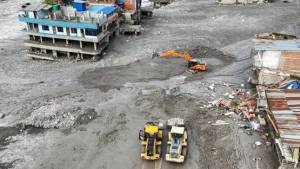
Rescue teams battled through thick mud on Thursday as they searched for more than 1,400 people reported missing after devastating flash floods and landslides struck areas along the Nepal-Tibet border.
The death toll has risen sharply to at least 362, with entire villages swept away by massive torrents of mud and debris that destroyed homes, bridges and dams and carried vehicles away.
Authorities warned of the possibility of further flooding as huge amounts of debris continue to block waterways in the affected region.
According to the US Geological Survey (USGS), the disaster was triggered by a glacial collapse that generated a massive flow of ice, mud and debris downstream.
Emergency crews were working to rescue survivors, while Nepali soldiers deployed sniffer dogs to search for people buried beneath the mud.
“It is a giant graveyard,” Omkar Joshi, a 35-year-old Nepali customs agent rescued from a hilltop in the border town of Timure, told AFP, describing the devastation left behind by the disaster.
Nepali police said they had recovered 359 bodies, while authorities reported that another 910 people, including 517 foreign tourists, remained out of contact.
China said that 100 Chinese citizens were among those missing in Nepal.
Heavy Losses on the Tibetan Side
In China’s Tibet Autonomous Region, state media reported that the mudslide disaster at Gyirong Port killed three people, while 558 people, including 260 foreigners, remained missing.
Chinese Premier Li Qiang visited the affected area on Thursday to oversee emergency rescue and relief operations and meet rescue workers and residents affected by the disaster.
Chinese officials said nearly 800 emergency personnel, along with sniffer dogs and speedboats, had been deployed to assist in the search and rescue effort.
Rescue operations have been complicated by difficult mountainous terrain, narrow roads and concerns over instability in an upstream reservoir lake.
Access to Tibet remains heavily restricted for foreign journalists, making independent reporting from the affected areas difficult.
Disaster Described as an “Inland Tsunami”
Nepal’s Prime Minister Balendra Shah visited several of the hardest-hit areas on Thursday and instructed local authorities to provide immediate assistance to displaced families and reopen blocked roads.
Nepal’s tourism authorities said those missing included nationals of India, Australia, Britain, Malaysia, the Netherlands, Portugal, South Africa, South Korea and the United States.
Environmental historian Ruth Gamble of Australia’s La Trobe University described the sudden surge of mud and debris as resembling an “inland tsunami” that traveled nearly 170 kilometers south into Nepal.
The northern district of Rasuwa was among the first areas hit, while deaths were reported as far south as Chitwan near the Indian border.
The Dalai Lama, who lives in exile in India, expressed his condolences and said he would pray for those who lost their lives.
International relief organizations have also begun responding. The International Federation of Red Cross and Red Crescent Societies said it was sending emergency supplies, including blankets, first-aid kits, stretchers and body bags.
USGS Attributes Disaster to Glacial Collapse
The USGS said the initial seismic activity was first reported as a magnitude 4.4 earthquake, but further analysis showed that the event was instead caused by a glacial collapse and massive debris flow.
Scientists have warned that climate change is contributing to the accelerated melting of glaciers around the world, increasing the risk of glacial lake floods and sudden glacial collapses.
Authorities remain particularly concerned about large quantities of water trapped behind debris blocking the valley.
Qianggong Zhang, head of climate and environmental risks at the International Center for Integrated Mountain Development in Kathmandu, warned that another flood could occur if the blockage upstream along the Nepal-China border gives way.
Nepal’s Flood Forecasting Division issued a special warning on Thursday, urging residents, travelers and rescue workers downstream along the Bhote Koshi River to exercise extreme caution because a lake is forming behind the landslide debris.
Hindu Pilgrims Among Those Missing
A number of Hindu pilgrims from around the world are also believed to be among the missing.
Indian spiritual leader Sadhguru said that scores of devotees returning from a pilgrimage to Mount Kailash on the Chinese side of the border were caught by the floods near an immigration facility.
In an emotional video message, he said the pilgrims had been inside the building when the disaster struck, describing the incident as a “terrible and extraordinary event.”
Search and rescue operations continue on both sides of the Nepal-Tibet border as authorities race against time to locate survivors and assess the full scale of the disaster.