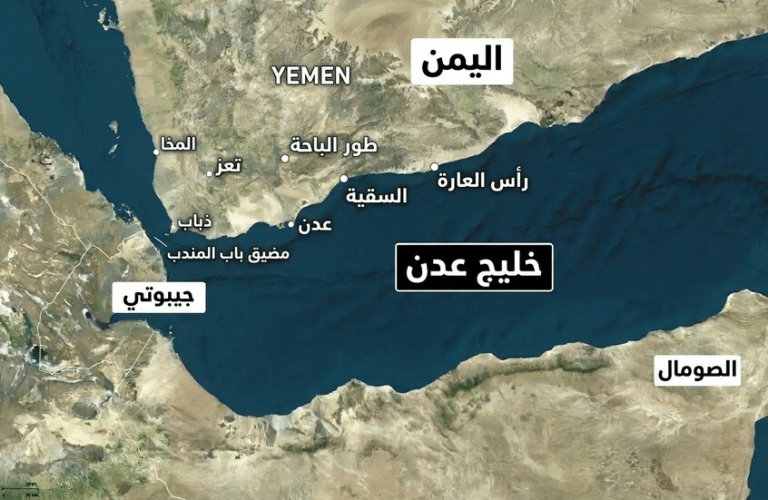

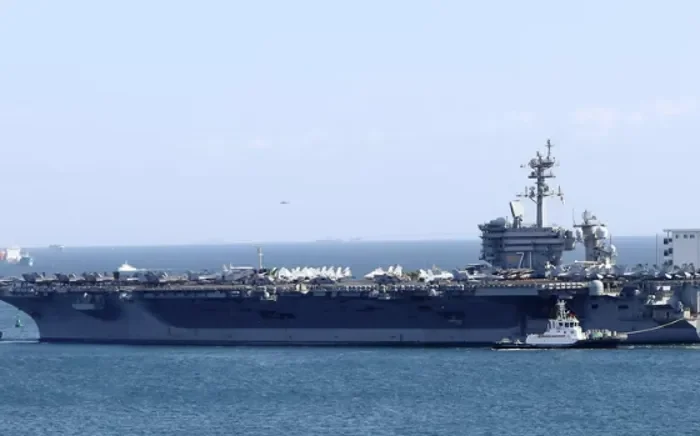
A U.S. official confirmed on Monday that the American aircraft carrier USS Theodore Roosevelt has arrived in the Middle East, specifically within the area of responsibility of U.S. Central Command (CENTCOM), amid rising tensions with Iran and an expanded U.S. naval presence in the region.
The official told Al Arabiya English that the carrier’s arrival brings the number of U.S. aircraft carriers deployed in the Middle East to three.
From San Diego to the Middle East
The USS Theodore Roosevelt departed its naval base in San Diego, California, on September 27, beginning a journey across the Pacific Ocean before heading west to participate in the Keen Sword 27 military exercises with Japanese forces, which concluded on October 29.
The carrier strike group arrived in Singapore on November 6 for a port visit before resuming its journey on November 8 and 9, passing through the Strait of Malacca toward the Indian Ocean and eventually reaching the U.S. Central Command area of operations, according to USNI News, the publication of the U.S. Naval Institute.
What Happens to the USS George Washington?
The USS Theodore Roosevelt is expected to replace the USS George Washington carrier strike group, which has been operating in the region since August 19.
The U.S. naval deployment in the Middle East currently includes the USS George Washington and the USS George H.W. Bush, alongside the newly arrived Theodore Roosevelt.
It remains unclear whether Washington will keep all three aircraft carriers in the region for an extended period or whether the USS George Washington will depart following the arrival of the Theodore Roosevelt.
A Strike Group with Advanced Air and Naval Capabilities
The Theodore Roosevelt Carrier Strike Group includes Carrier Air Wing 11, the guided-missile cruiser USS Chosin, and the destroyers USS Paul Hamilton and USS Decatur.
The group provides a wide range of military capabilities, including fighter aircraft, airborne early-warning systems and electronic warfare assets, as well as missile defense systems and offensive capabilities provided by its escort ships.
The deployment is part of a broader repositioning of U.S. naval forces in the Middle East, giving American military commanders additional operational options amid ongoing regional tensions with Tehran.