
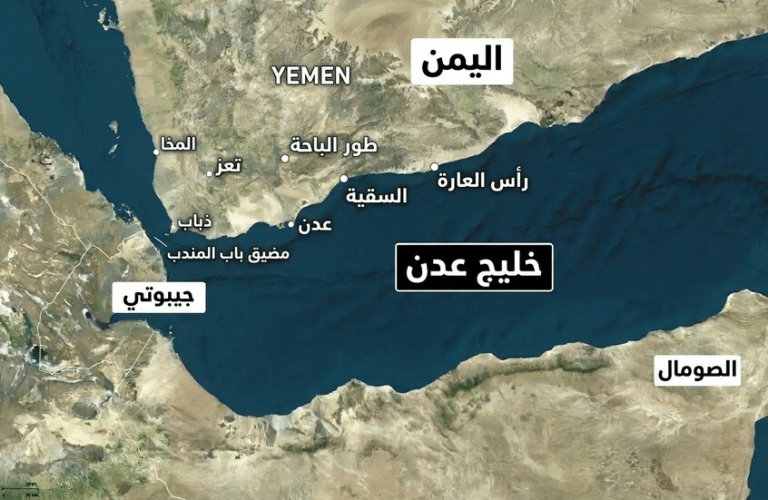
Yemeni government forces announced on Sunday that they were redeploying their units and withdrawing from the area overlooking the Bab el-Mandeb Strait, in a move aimed at focusing on the defense of the interim capital, Aden. Reuters described the development as a major military setback for government forces.
According to the news agency, the announcement effectively marks the end of a six-week counteroffensive aimed at regaining control of the coastline near the entrance to the Red Sea, after the Houthis seized the area in a rapid advance last September that put pressure on oil exports.
The implications of the move extend beyond Yemen’s battlefield, affecting Saudi interests and regional trade and energy flows. Bab el-Mandeb is a vital route for Saudi oil exports through the Red Sea, particularly amid the disruption of shipping through the Strait of Hormuz.
Conflicting Accounts of the Withdrawal
The Yemeni government and the Houthis offered conflicting accounts of developments around Bab el-Mandeb and Dhubab Airport. While government forces described the move as a redeployment toward Al-Mudharaba and Ras al-Ara to protect front lines and help lift the siege of Taiz, the Houthis claimed they had forced the forces to withdraw following a flanking operation and clashes stretching more than 60 kilometers.
The developments coincided with escalating fighting in the governorates of Taiz, Marib and Al-Jawf.
Reuters quoted the Southern Armed Forces, the main military force fighting alongside the government in southern Yemen, as saying they were carrying out a “redeployment” from Dhubab Airport and the Bab el-Mandeb area in western Taiz governorate. The move, it said, was driven by the priority of securing Aden and neighboring provinces, strengthening front lines and addressing existing threats.
Israel’s Yedioth Ahronoth reported a similar account, saying the forces were retreating toward Aden as the Houthis intensified pressure on the remaining government-held areas in the south.
Media outlets differed in their descriptions of the outcome. The Jerusalem Post and Daily Sabah reported that government forces had withdrawn, leaving the Houthis in control of the strait. Reuters, however, offered a more cautious account, saying the forces had redeployed to Al-Saqiyah, south of Dhubab and about 150 kilometers west of Aden, while continuing efforts to push the Houthis away from nearby coastal areas, citing Yemeni military sources.
Consequently, it remains difficult to conclude that the Houthis have gained full control of the Bab el-Mandeb Strait, although the balance of power along the coastline appears to be shifting in their favor.
How Did the Situation Reach This Point?
Reuters traces the escalation to the renewed outbreak of Yemen’s civil war this summer, following a period of relative stalemate since 2022, as an extension of the regional conflict launched by the United States and Israel against Iran in February.
According to the agency, the Houthis made rapid gains along the Red Sea coast and around Bab el-Mandeb, while besieging government forces in Taiz, Yemen’s third-largest city.
Other reports provide a more detailed timeline. According to the South24 Center and Ahram Online, the city of Mokha fell on September 10 following the withdrawal of government and joint forces. The Houthis reached Dhubab the following day.
Euronews reported that the Houthis deployed across the Hanish Islands after hundreds of pro-government fighters withdrew. Sultan al-Arada, a member of Yemen’s Presidential Leadership Council, described the collapse of forces in Mokha as “painful and regrettable.”
The Austrian outlet Militär Aktuell reported that the Houthis seized Dhubab and the village of Murad before crossing by boat to Mayyun Island, also known as Perim, following the withdrawal of government forces.
Reuters noted that a government counteroffensive last month recaptured key positions around the strait, particularly Dhubab, but failed to drive the Houthis out completely or retake Mokha.
This indicates that front lines shifted several times over two months, helping explain the differences between accounts of control over coastal areas, depending on when each report was published.
Taiz: The Front That Undermined the Government Offensive
According to Yemeni military sources cited by Reuters, Houthi gains around Taiz, which has become one of the fiercest battlefronts in the war, undermined the government’s military campaign near Bab el-Mandeb.
The Houthis cut off routes into the city in early October and are now, according to the agency, positioned outside Tur al-Baha district in Lahj governorate, about 80 kilometers from Aden.
Reuters reported that fighting was intensifying in western Taiz, while the city remained under siege, preventing aid from entering and civilians from leaving. Taiz is home to roughly half of the 300,000 people displaced by the recent fighting.
On the same day, the International Committee of the Red Cross announced that the Houthis had released 600 detainees, a humanitarian development that does not alter the broader military situation.
These developments suggest that the Yemeni government faced a difficult choice between continuing its campaign along the coast, far from its military center of gravity, and reinforcing defenses closer to Aden, its main base in the south.
The government chose to prioritize the protection of Aden, according to its statement. The coming days will determine the actual scale of the setback and whether the Houthis can advance toward Lahj and the interim capital.
Bab el-Mandeb: Strategic Importance for Saudi Oil Exports
The government withdrawal came amid continued Houthi drone and missile attacks on Saudi Arabia, which have struck major airports and energy facilities, raising concerns in global energy markets, Reuters reported.
Energy market analyses help explain the strategic importance of Bab el-Mandeb for Riyadh. According to AGBI, the Red Sea port of Yanbu has become the main outlet for Saudi crude exports since Iran effectively closed the Strait of Hormuz.
The publication quoted PIMCO as saying that around 92% of Saudi exports through Red Sea ports, equivalent to approximately 4.3 million barrels per day, pass through Bab el-Mandeb.
In July, Agence France-Presse, through Al-Monitor, reported that exports from Yanbu had nearly tripled to a record level of close to four million barrels per day during the spring.
The National also cited Kpler data showing that Saudi crude shipments fell by 36% when Houthi threats escalated in July. That same month, the Houthis announced attacks on two Saudi tankers and declared a naval blockade against the kingdom, according to reports by AFP and Gulf News.
However, these indicators do not necessarily mean that the strait is facing a complete or sustained closure. A Kpler analysis in July suggested that selective enforcement of a blockade was more likely, at least for the time being, than a prolonged shutdown of the waterway.
Reuters’ latest report also did not mention any closure of the strait or new attacks on shipping, but pointed to the possibility of further Houthi advances toward Aden.
Meanwhile, OilPrice argues that the Suez Canal would not be able to fully compensate for the Red Sea’s role if Bab el-Mandeb were closed. Kpler data cited by Intelligence News indicate that around six million barrels of crude oil pass through the strait daily toward Asia, approximately two-thirds of which is Saudi oil. This leaves Asian refineries particularly exposed to any disruption.
Four Indicators to Watch in the Coming Days
Attention is now focused on four key developments that could shape the next phase of the conflict in Yemen and its regional implications:
- The positions of the Yemeni government and Saudi Arabia: No immediate response to the withdrawal was reported, and their official positions could reveal the nature of military and political coordination in the coming period.
- Houthi movements in Lahj and around Aden: These developments will be crucial in determining whether the government forces’ redeployment is an organized tactical move or the beginning of a broader military retreat.
- The humanitarian situation in Taiz: The continued siege and escalating fighting threaten to worsen the humanitarian crisis, amid difficulties in delivering aid and allowing civilians to leave.
- The Houthis’ approach to maritime traffic: Their treatment of ships, tankers and Saudi export ports will remain a critical factor. Any shift from ground pressure to attacks on shipping could quickly affect global energy markets and international trade.
As government forces attempt to reorganize their military priorities to protect Aden, Bab el-Mandeb remains a strategic focal point whose importance extends far beyond Yemen, affecting energy security and international trade.