
An Israeli analysis has warned that the regional changes that have unfolded since October 7, 2023, have dealt a major blow to the foundations of the Abraham Accords, arguing that normalization between Israel and Arab countries can no longer be separated from the Palestinian issue.
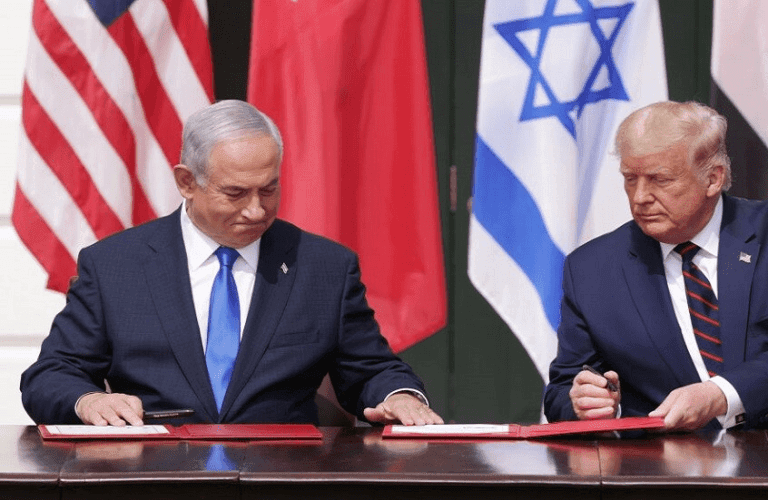
Professor Eli Bodeh of the Hebrew University said in an analysis published by Israel’s public broadcaster that the agreements, which were reached during U.S. President Donald Trump’s first term with the aim of normalizing relations between Israel and several Arab countries without resolving the Palestinian issue, have lost much of their effectiveness amid the region’s changing dynamics.
According to the analysis, Israel’s continued military operations in the Gaza Strip have prompted Arab countries to reconsider the nature of their relations with Israel, making it increasingly difficult to view the country as a strategic partner independently of the Palestinian question.
New Regional Alliances Emerging
The analysis argues that the region is witnessing the emergence of “flexible alliances” that go beyond the traditional division between what was known as the “Axis of Resistance” and the “moderate Arab camp.”
Among the new regional groupings cited are the “Group of Eight” Islamic countries and a quadrilateral grouping involving Turkey, Pakistan, Saudi Arabia and Egypt, in addition to emerging defense arrangements between Saudi Arabia, Turkey and Pakistan.
Bodeh noted that these new alliances do not include Israel or place its security interests among their priorities, describing this as a sign of Israel’s growing diplomatic isolation in the region.
Red Sea Security Cooperation Excludes Israel
The Red Sea provides a clear example of this regional shift, according to the analysis. New maritime security arrangements have been established to protect shipping from threats posed by the Houthi movement, with the participation of 14 countries, including Egypt, Turkey and Pakistan.
Israel, however, has remained outside these arrangements despite its direct security and economic interests in the stability of the region.
The analysis argues that common threats, which previously served as a factor bringing Israel and some Arab countries closer together, are no longer sufficient to overcome political disagreements linked to the Palestinian issue.
Abraham Accords Need a New Approach
Bodeh concluded that the Abraham Accords are no longer sufficient as a framework for regional normalization, arguing that any future Israeli government will need to develop a new approach to relations with countries in the region.
Such an approach, he said, would need to include recognition of Palestinian rights and an end to policies that contribute to further regional tensions.
The analysis warned that ignoring these changes could leave Israel facing continued and potentially deeper regional diplomatic isolation in the coming period.