
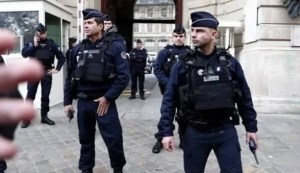
France was deploying extensive security measures across major cities ahead of a new wave of protests on Saturday, with police, helicopters and armored vehicles mobilized to prevent a repeat of the violence and looting that erupted during nationwide demonstrations last weekend.
Shops and restaurants in central Paris were boarded up, the world-famous Louvre and Musée d’Orsay museums were closed, and a curfew was imposed in parts of the French capital ahead of hundreds of planned demonstrations across the country.
Police Fire Tear Gas in Lyon
Police fired tear gas on Saturday to disperse around 150 protesters in the southeastern city of Lyon, where demonstrations were prohibited, an AFP journalist reported.
Officers fired several tear gas grenades to disperse the group gathered near a university faculty building and the city’s police headquarters as part of nationwide rallies against the rising cost of living. Police intervened as demonstrators attempted to block the road.
Protests initially driven by high school students over learning conditions have expanded nationwide, fueled by broader public anger over the increasing cost of living.
However, some of the worst urban violence in years erupted on the sidelines of demonstrations a week earlier, when more than half a million people took to the streets.
Interior Minister Laurent Nunez said around 70,000 security personnel would be deployed on Saturday. Prime Minister Sebastien Lecornu warned late Friday that the threat of violence “remains high.”
Political Tensions Ahead of Elections
The demonstrations come at a critical moment for France, six months before elections to replace President Emmanuel Macron. A new poll has identified far-right candidate Marine Le Pen as the frontrunner, suggesting that recent events have further strengthened her position.
Tensions have also risen ahead of Le Pen’s National Rally (RN) party congress in Orleans this weekend, where thousands of supporters are expected to gather. Local authorities fear clashes as counter-protesters also head to the city, south of Paris.
Shops in Orleans were boarded up, and residents expressed concern about the security situation.
“The atmosphere is truly strange for a Saturday morning; everything is closed, and some businesses are barricaded. We really hope the security measures will prevent the kind of violence we saw last week,” local resident Stephane Gentil told AFP while out cycling.
Macron met representatives of secondary school students on Friday, but the students left the talks urging their peers to continue protesting until the government presented concrete proposals addressing their demands.
Courts Send 217 People to Prison
Macron’s government has sought to distinguish between protesters’ legitimate demands and the looting, arson and destruction that accompanied demonstrations last Saturday. Officials have blamed the violence on “ultra-left” groups.
Courts have already sentenced 217 people to prison over the incidents, officials said. Half of those sentenced were first-time offenders.
An extreme-left group in western France published a message on its website urging supporters to remain “uncatchable, unpredictable, to evade the deployment” of police.
Authorities have tightened security and imposed restrictions on demonstrations in several cities.
In Orleans, between 20,000 and 30,000 people are expected to demonstrate against Le Pen’s National Rally, but the gathering will be prohibited from entering the city center, according to the prefecture.
In Lyon, central areas will also be off-limits to demonstrators over the weekend.
In Paris, police revoked an earlier permit allowing union-led protesters to march between Bastille and Nation squares in the eastern part of the city, authorizing an alternative route instead. Unions vowed to proceed along the prohibited route, citing safety concerns about the alternative.
Authorities in Marseille had also banned demonstrations but announced on Friday that a union-organized protest would be permitted on an “exceptional basis.”
Rights Groups Criticize Protest Restrictions
Restrictions on demonstrations, including outright bans in some cities, have drawn criticism from rights organizations.
Amnesty International denounced what it described as “a slide toward authoritarian practice,” warning that the measures were “jeopardising the right to demonstrate peacefully.”
Around 20 percent more security personnel will be deployed this weekend following questions about police preparedness and intelligence gathering ahead of last weekend’s violence.
“Police have a responsibility both to ensure that protests can take place peacefully and safely and to protect the public from violent disorder,” said Eva Cosse, senior Europe researcher at Human Rights Watch.
She also expressed concern over reports that children had suffered serious injuries from crowd-control weapons during recent demonstrations.
The unrest has damaged France’s image ahead of elections that could mark a turning point in the country’s modern history. Meanwhile, the government’s growing debt burden continues to worry investors.
Polls cited in the report indicate that Le Pen is on course to win both the first and second rounds of the presidential election.