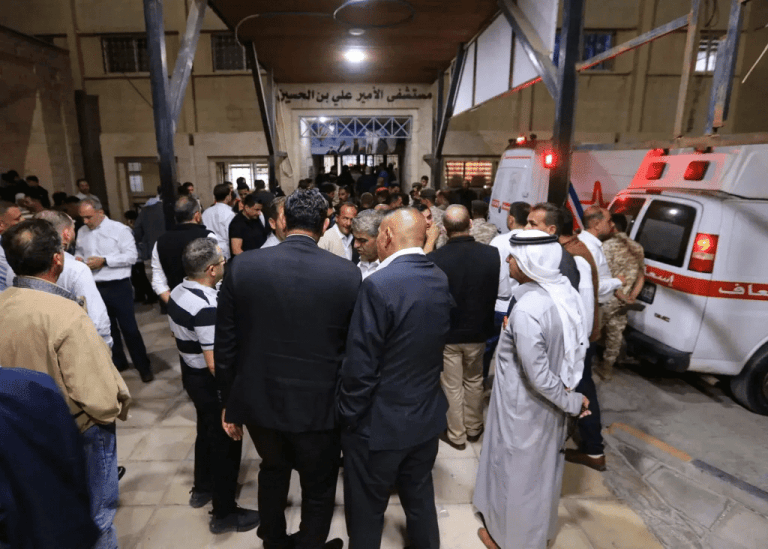


The death toll from an attack on a church in the village of Hamoud in Jordan’s southern Karak Governorate rose to nine on Saturday after another injured victim died from their wounds. King Abdullah II ordered security agencies to respond firmly, pursue those involved, and conduct a comprehensive security review to strengthen the country’s ability to prevent similar attacks, amid continued Arab and international condemnation.
Jordan’s Public Security Directorate announced on Saturday that one of the injured victims had died, raising the death toll to nine. Authorities had initially reported seven deaths and 27 injuries on Friday, before two additional deaths were recorded on Saturday.
Karak Government Hospital Director Ali Al-Sarayreh said three injured people were discharged on Saturday evening after receiving treatment and their conditions stabilized. Two others remained under medical care until their conditions improved sufficiently.
Jordanian Health Minister Ibrahim Al-Badour had earlier reported that one patient was in critical and unstable condition after suffering severe bleeding.
The Jordan News Agency, Petra, reported that Royal Court Chief Yousef Hassan Al-Issawi followed up on the medical conditions and needs of the injured. He visited patients at Karak Military Hospital, Karak Government Hospital, the Italian Hospital, Al-Bashir Hospital and King Hussein Medical City in Amman.
Details of the Attack on St. George’s Church
The attack took place on Friday during a funeral service at St. George’s Church in the village of Hamoud in Karak Governorate. Gunmen opened fire on people inside and around the church.
In an initial statement, the Public Security Directorate said unidentified gunmen had carried out the attack, adding that search and investigative operations were underway to identify those responsible, track them down and bring them to justice.
Jordan’s interior minister described the incident as “a terrorist operation carried out by a group of extremists,” stressing that the necessary measures were being taken to address its consequences and assist the victims’ families.
King Abdullah II visited the injured at Karak Government Hospital on Friday to check on their conditions and vowed that those responsible would face the harshest penalties.
“Those who thought that treacherous bullets could divide Jordanians have failed in the face of our resilience and unity,” he said during the visit.
Crown Prince Hussein bin Abdullah II said that “the bullets of cowardly terrorism will not undermine Karak or its history, which is full of honor and dignity,” emphasizing that Jordanians remained committed to unity in confronting attempts to threaten the country’s security.
Queen Rania Al Abdullah described the attack as “a heinous crime that has deeply saddened us all,” adding that the suffering of the residents of Hamoud was shared by all Jordanians.
Air Evacuations for the Injured and Three Days of Mourning
The Jordanian Armed Forces announced early Saturday that eight injured people had been evacuated by a Royal Jordanian Air Force helicopter to King Hussein Medical City, following royal directives.
Al-Mamlaka TV reported that three patients were transferred to a private hospital, while other injured people continued receiving treatment at Prince Ali Military Hospital and other medical facilities.
Prime Minister Jafar Hassan announced three days of national mourning across Jordan on Friday, effective from the day of the attack. Flags were to be flown at half-mast over ministries, government departments, public institutions and agencies.
Publication Ban in the Case
As investigations continued, Amman Attorney General Hassan Al-Abdallat issued a publication ban in the case under Jordan’s Press and Publications Law and Penal Code.
The decision applies to media outlets, electronic platforms and social media, with an exception for official government media outlets operating under the supervision of the Ministry of Government Communication.
Al-Abdallat said the ban aims to protect the investigation, prevent the circulation of information and evidence that could affect the course of justice, safeguard the privacy of victims and their families, and counter misinformation and hate speech.