
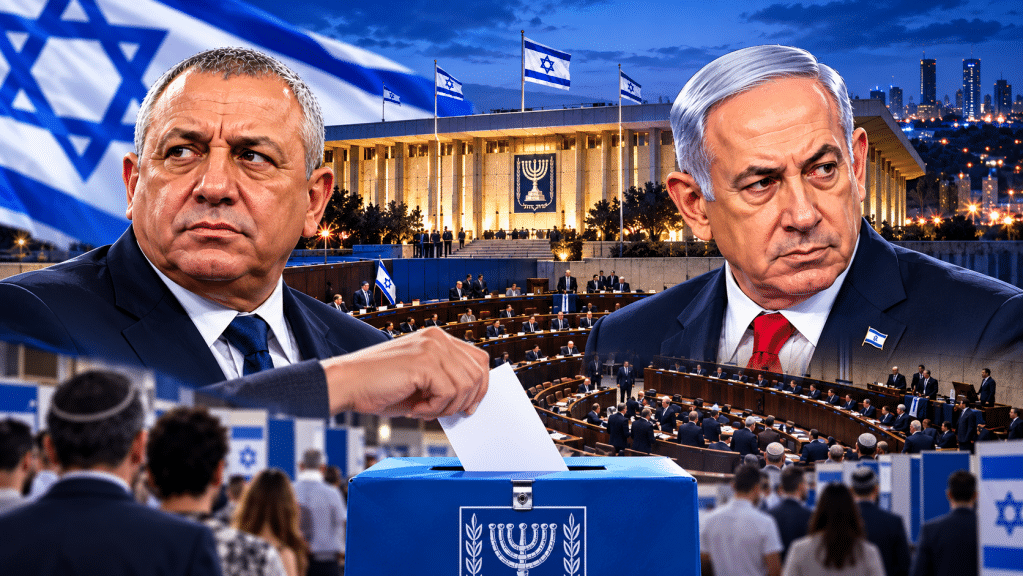
Israel’s election results remain uncertain as seat projections fluctuate between Prime Minister Benjamin Netanyahu’s bloc and the opposition camp led by Gadi Eisenkot. Differing exit-poll samples broadcast by Israeli television channels have made it difficult to determine which side is best positioned to form the next government.
Updated projections from Channel 12 showed either a tie or a narrow lead for Netanyahu’s bloc. One sample gave his camp 52 seats compared with 49 for Eisenkot’s camp, while other updates projected 53 seats for Netanyahu and 49 for Eisenkot. In one estimate, Arab parties were projected to win 19 seats.
Meanwhile, samples published by Channel 13 and Israel’s public broadcaster showed both camps securing 51 seats each. Channel 14, which is widely considered sympathetic to Netanyahu, projected 62 seats for his bloc, enough to cross the 61-seat threshold required to form a government in the 120-member Knesset.
Remaining Votes Keep the Outcome Uncertain
Attention is now focused on the remaining ballots, particularly double envelopes, which are expected to affect the final distribution of seats. The count is expected to be completed by Thursday afternoon, according to the projections cited in Israeli media reports.
Figures circulating in some exit polls put Arab parties at between 18 and 19 seats, highlighting their significant presence in the electoral landscape. However, the final results have yet to be determined.
Rival Camps Issue Contrasting Statements
In his first remarks following the release of the exit polls, Gadi Eisenkot said his party had made history, arguing that voters had chosen change. He pledged to work toward forming a new government and criticized Netanyahu, warning against using security issues to advance political objectives.
Former Prime Minister Naftali Bennett, meanwhile, declared that Netanyahu had lost, saying efforts to coordinate among the parties in the change camp were continuing to form a government. Yair Lapid also called for efforts to establish a government, even if it was not ideal at the outset.
By contrast, Channel 14’s projection showed Netanyahu’s bloc winning enough seats to form a government on its own. Itamar Ben-Gvir warned against forming a unity government that included Eisenkot, arguing that such an administration would be unable to operate effectively.
Political Divisions and Sharp Statements
The latest hours have seen a series of conflicting statements from party leaders. Avigdor Lieberman urged Likud lawmakers to rebel against Netanyahu and called on him to leave political life. Remarks by some politicians concerning Arab parties have also sparked controversy amid the competition to form the next government.
Separately, data from the Central Elections Committee showed a notably high voter turnout. Some reports put the final turnout at 77.7%, while Israeli television estimates indicated strong participation among Arab voters.
All seat projections based on exit polls remain provisional until official results are announced. The formation of the next government will depend on the final distribution of seats and each camp’s ability to secure the support of at least 61 Knesset members.