

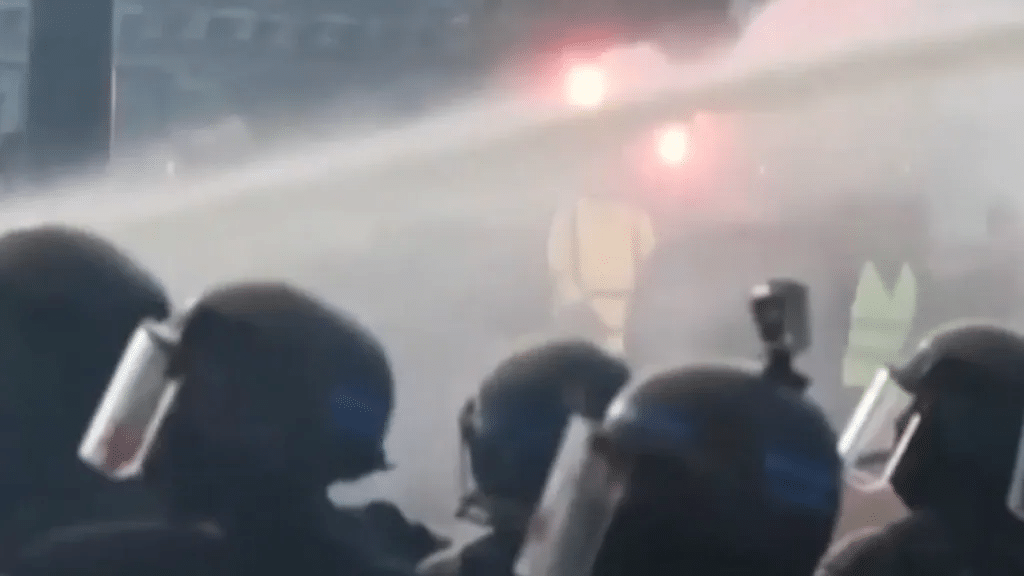
The use of chemical marking technology to track suspects in France has sparked debate over the limits of security surveillance and protesters’ rights, as the issue returned to the spotlight amid demonstrations across the country in October 2026.
The technology relies on chemical substances that can leave marks invisible to the naked eye on people’s skin or clothing. Some of these traces can later be detected using specialized equipment, potentially allowing authorities to link individuals to specific locations or incidents after protests have ended and crowds have dispersed.
Civil liberties advocates are concerned that such markings could be used to detain people simply because they were present at a protest site, even though detecting a chemical trace does not, by itself, prove that someone committed a crime or participated in violent acts.
How Does Chemical Marking Technology Work?
Known in French as marquage codé, the technique is sometimes described in media coverage as chemical marking or coded marking. The term “DNA marking,” occasionally used in reporting, does not necessarily mean that actual DNA is involved.
Some systems leave distinctive traces on individuals or their clothing that can later be revealed using appropriate detection methods. Depending on the substance and its coding system, investigators may then analyze the traces and attempt to link them to a particular incident or operation.
Such evidence may help investigators identify people who came into contact with a substance or associate them with a particular location. However, it cannot independently establish how the substance reached them or whether they committed an offense.
Sainte-Soline Protests Bring the Issue Back Into Focus
The controversy surrounding chemical marking in France did not begin in October 2026. It gained prominence during protests in the Sainte-Soline area in March 2023, when demonstrators opposed a water reservoir project.
Reports of chemical marking during clashes raised questions about the detention of people found to have traces of the substances, including a journalist who said he had been present to cover the events.
The central concern is that a mark may result from direct exposure to a substance or transfer through physical contact. Its presence alone is insufficient to establish that an individual participated in violence or vandalism.
In October 2026, French media reports brought renewed attention to the issue amid discussions of parliamentary recommendations to expand the use of identification methods, including chemical marking. The debate has focused on the legal safeguards needed to regulate such practices.
Concerns Over the Right to Protest
The debate over chemical marking pits security considerations against concerns about civil liberties.
Supporters argue that the technology could help police investigate assaults and vandalism and identify suspects after they have left the scene.
Critics, however, warn that peaceful demonstrators, journalists and medical personnel could be exposed to these substances without committing any offense, potentially leading to mistaken suspicion or detention.
This raises fundamental questions about how authorities establish a connection between a person carrying a mark and an illegal act, how reliable the resulting evidence is, and whether defendants have a meaningful opportunity to challenge it in court.
What Are the Potential Health Risks?
The health effects of substances used in chemical marking vary according to their composition, concentration and method of exposure. These substances therefore cannot all be assumed to have the same safety profile.
Some chemicals used in sprays may cause skin or eye irritation, while inhaling droplets may irritate the nose, throat or respiratory system, depending on the ingredients and concentration.
People with sensitivities to particular substances or pre-existing respiratory conditions may face additional risks. The possibility that traces could remain on skin or clothing also raises questions about how long exposure may continue and whether residues can be transferred through contact.
However, an invisible substance is not necessarily toxic, just as a substance used for identification cannot automatically be considered risk-free. A reliable assessment requires information about its chemical composition and specific safety data.
Who Oversees the Use of Surveillance Tools?
The debate extends beyond the technology’s effectiveness to the safeguards governing its use, the authorities permitted to deploy it, the handling of associated data and the judicial scrutiny of evidence obtained through the process.
Balancing public security with civil liberties requires clear rules specifying when these substances may be used, alongside judicial oversight that allows the evidence and the procedures used to obtain it to be examined.
As the debate continues in France, the central question remains how authorities can use technological tools to investigate crimes without treating mere presence at a demonstration as proof of guilt or undermining citizens’ right to peaceful protest.