
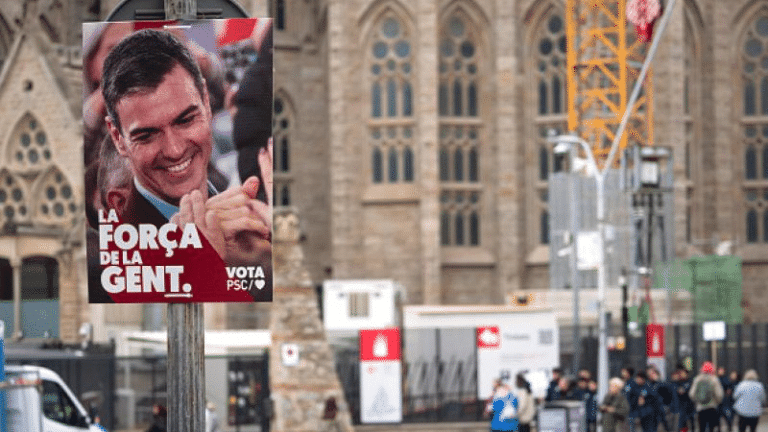
More than 38 million voters in Spain are heading to the polls on Sunday to cast their ballots in an early general election, as attention focuses on the future of the left-wing coalition government led by Prime Minister Pedro Sánchez, amid expectations that the country’s political landscape will continue to be shaped by party alliances.
Opinion polls indicate that the People’s Party (PP), the main opposition party, is leading the race, with projections suggesting that it could secure a parliamentary majority alongside the far-right Vox party, enabling the two parties to form a coalition government.
Why Spain Is Holding an Early Election
General elections in Spain are normally held every four years, with the last vote taking place in July 2023. The current election was brought forward after Prime Minister Pedro Sánchez announced on October 5 that he would call an early vote, following Parliament’s rejection of urgent measures proposed by his left-wing coalition government to address the housing crisis, which had sparked widespread protests across the country.
Opinion polls suggest that forming a coalition government will remain necessary, continuing a political approach that first emerged in Spain in 2019 and remained in place following the 2023 election.
The next political phase revolves around two main possibilities: the current left-wing coalition remaining in power or the formation of a new government alliance between the two right-wing opposition parties.
Challenges Facing Sánchez’s Government
Pedro Sánchez, leader of the Spanish Socialist Workers’ Party (PSOE), has contested three elections over the past eight years and has led the government through different political coalitions. However, his latest term, which began in 2023, has been marked by numerous challenges.
Among the most significant was the arrival of around 80,000 irregular migrants from Morocco into the Spanish-administered city of Ceuta on the northern coast of Africa in late July, alongside the worsening migration situation in the Canary Islands.
The government also faced the consequences of two high-speed train accidents within a single year, which claimed more than 100 lives, as well as corruption allegations involving Sánchez’s wife, his brother and two senior officials in his party.
Other difficulties included the government’s failure to present a budget proposal during certain parliamentary sessions because it lacked a majority, along with its inability to pass several bills, forcing it to govern through decrees.
People’s Party Platform and Immigration Policy
The People’s Party, which came first in the previous election but remained in opposition because it could not secure sufficient support to form a government, has pledged to build one million housing units, cut income taxes and tighten immigration policies as part of its election platform.
Irregular immigration has emerged as one of the central issues in the current campaign, with right-wing and left-wing parties taking sharply different positions on how to address it.
The People’s Party and Vox have proposed deploying naval forces along Spain’s southern coast to secure the borders and stop boats carrying irregular migrants. They also oppose the government’s decision to launch a new process to regularize migrants’ status earlier this year, which attracted applications from more than one million irregular migrants.
By contrast, the Spanish Socialist Workers’ Party and the left-wing alliance known as the Broad Front argue that Spain needs migrants. They advocate agreements with third countries to organize legal migration while defending migrants’ human rights.
Sánchez Warns Against a Return of the Right
During his election campaign, Prime Minister Pedro Sánchez said voters faced a choice between “reactionary politics” and “progressive politics,” describing his government as “democratic, progressive and liberal.”
Sánchez accused the right and far right of pursuing policies that would lead to “democratic regression and austerity,” comparing their positions with those of US President Donald Trump and Argentine President Javier Milei.
He also accused influential wealthy individuals, major corporations and “technological oligarchs” of supporting the right. Sánchez argued that a rise in voter turnout from the 66% recorded in 2023 to more than 75% in the current election could improve the chances of the Socialist government remaining in power for another four years.
Foreign Policy Largely Absent From Campaign Debate
Foreign policy received relatively little attention during the election campaign, despite several major decisions taken by Sánchez’s government, including recognizing the State of Palestine, imposing an arms export ban on Israel and prohibiting imports of products from Israeli settlements.
The government also opposed US-Israeli attacks on Iran and imposed restrictions on the use of Spanish military bases and Spanish airspace for those attacks. It has also provided full support to Ukraine in the face of what it describes as the “Russian invasion” and opposed increasing NATO members’ defense spending to 5% of gross domestic product.
Meanwhile, right-wing parties, which oppose Sánchez’s foreign policy decisions and largely support US President Donald Trump, have focused their criticism of the Socialist government on immigration and corruption allegations.
Opinion Polls and Projected Parliamentary Seats
Opinion polls indicate that the People’s Party is expected to finish first, with projections suggesting that it could secure more than 190 parliamentary seats together with Vox, giving the two parties an absolute majority and the ability to form a government.
Projections for the main parties’ seat totals range as follows:
- People’s Party: 112 to 146 seats.
- Spanish Socialist Workers’ Party: 100 to 133 seats.
- Vox: 44 to 75 seats.
- Broad Front alliance: 8 to 17 seats.
38.6 Million Registered Voters
A total of 38,616,949 voters are registered for the general election, including 1,615,034 people voting for the first time.
The election will determine the composition of the 350-member Congress of Deputies and 209 members of the Senate. Voting will take place at 22,000 polling stations equipped with 210,000 ballot boxes, from 9 a.m. until 8 p.m. local time.
Current Composition of the Spanish Congress
The Spanish Congress of Deputies has 350 seats, distributed among the parties and political groups as follows:
- People’s Party: 137 seats.
- Spanish Socialist Workers’ Party: 121 seats.
- Vox: 33 seats.
- Sumar alliance: 31 seats.
- Republican Left of Catalonia: 7 seats.
- Together for Catalonia: 7 seats.
- EH Bildu: 6 seats.
- Basque Nationalist Party: 5 seats.
- Union of the Navarrese People: 1 seat.
- Canarian Coalition: 1 seat.
- Galician Nationalist Bloc: 1 seat.