
Russia launched large-scale airstrikes on Ukrainian energy infrastructure on Tuesday, using dozens of missiles and hundreds of drones, causing widespread power outages across the country. The attacks came about a week before U.S.-mediated peace talks are scheduled to resume.
Ukrainian President Volodymyr Zelenskyy said the Russian assault targeted power plants and substations. He reported that Russian forces launched 289 drones, 17 ballistic missiles, and 59 cruise missiles overnight, in attacks stretching from the Black Sea port of Odesa in the south to the western Rivne region.
Zelenskyy added that three of the five thermal power plants operated by DTEK, Ukraine’s largest privately owned electricity producer, had been forced out of service.
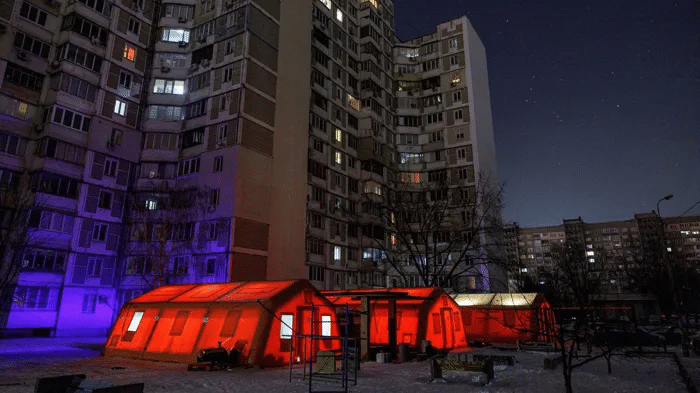
Kyiv Mayor Vitali Klitschko described the capital’s electricity situation as “extremely difficult,” saying the Russian attacks had damaged power generation capacity and transmission lines. The strikes triggered emergency power cuts and disrupted water supplies and public transportation.
Officials in the city of Dnipro reported that two people had been killed and around 20 others injured in the attacks. Prime Minister Serhiy Koretskyi said Russian shelling had also hit a railway station, passenger carriages, and locomotives.
Concerns Over Nuclear Safety
In a separate development, Ukrainian Energy Minister Denys Shmyhal said Russian forces had sent three drones toward a vital substation serving the Khmelnytskyi nuclear power plant.
Shmyhal warned that the attacks posed a threat not only to Ukraine but also to nuclear safety across Europe.
Khmelnytskyi is one of Ukraine’s four nuclear power plants. Another, the Zaporizhzhia facility, has been under Russian control since the early weeks of the invasion in February 2022.
The latest developments have raised fears that Ukraine could face a repeat of last winter’s crisis, when Russian strikes left millions of people without electricity and heating for days.
Olha Hyria, 49, who lives in Dnipro, said the coming winter would be extremely difficult, adding that attacks on electricity and heating facilities were making conditions increasingly challenging.
Natalia Danyliuk, also 49, said residents had begun stockpiling water, portable power banks, and other essential supplies. She added that they had purchased winter clothing and sleeping bags to prepare for the cold.
Strike on a School in Zaporizhzhia
Meanwhile, Zelenskyy said at least 33 people were killed on Monday in a Russian strike on a school in the frontline town of Komyshuvakha, near the front line in the Zaporizhzhia region. The building was being used to distribute humanitarian aid.
He added that around 50 people were believed to remain trapped under the rubble.
Russia’s Defense Ministry, however, said its forces had targeted Ukrainian military units near Komyshuvakha and two other locations in Zaporizhzhia. It claimed that up to 25 Ukrainian soldiers had been killed and 15 vehicles and an electronic warfare station destroyed.
Speaking at a news conference in Berlin alongside German Chancellor Friedrich Merz, Zelenskyy said the attack demonstrated Moscow’s determination to continue fighting rather than take advantage of the brief humanitarian ceasefire in the town of Oleshky and surrounding areas, which had been arranged with the assistance of Melania Trump.
Diplomatic Efforts to Resume Peace Talks
The attacks come about a week before negotiations between Ukraine, Russia, and the United States are scheduled to resume in Abu Dhabi on November 10 and 11, amid concerns that the military escalation could undermine prospects for an agreement.
German Chancellor Friedrich Merz described holding another round of negotiations as “the right step” toward ending the war, while stressing that Europe must be involved in the process.
He added that he had yet to see any indication that Russia was prepared to engage in serious negotiations over a ceasefire and a subsequent peace agreement.
The European Commission announced that it would host a meeting on Ukraine on Wednesday, bringing together representatives from the United States, Ukraine, NATO, and several European allies.
Zelenskyy said the meeting would discuss a “growth plan” and security guarantees for Ukraine, while NATO announced plans to hold further consultations on Thursday.
Attacks Coincide with U.S. Midterm Elections
Zelenskyy linked the timing of the attacks to the U.S. midterm elections, saying that Russia’s actions on election day sent a message to Washington. He urged Ukraine’s allies to provide additional air defense systems.
He said Moscow appeared to believe that the United States would not pay attention to the message, stressing the need for a response to the attacks.
Russia’s Defense Ministry, for its part, said the strikes targeted electricity facilities in several regions that supply power to military factories and the Ukrainian armed forces.
Russia has continued targeting Ukraine’s energy system since the beginning of the war more than four years ago, damaging power generation, distribution, and heating facilities. Ukraine, meanwhile, has intensified its attacks on Russian oil refineries during the current year.
Ukrainian officials described the latest assault as one of the largest attacks of the war. It caused power outages in Kyiv and at least six other regions, while also disrupting water supplies and transportation in the capital.