

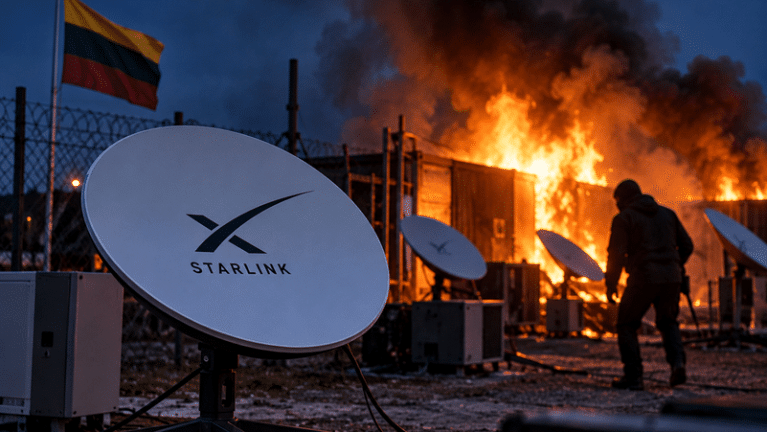
Lithuania has accused Russia of likely involvement in an attempted sabotage operation targeting communications facilities linked to the Starlink satellite network, which is used to support communications in Ukraine. The allegations followed the discovery of incendiary materials inside a company housing satellite communications equipment.
Lithuanian Prime Minister Mindaugas Sinkevicius told public television that the incident occurred at around 2 a.m. local time. The targeted company housed nine satellite communications antennas and a control unit.
He explained that the equipment enables connections to the Starlink network and helps maintain communications with Ukraine, but did not disclose the location of the facility.
Sinkevicius described the incident as a deliberate act of sabotage and said it could be part of what he called Russia’s “hybrid warfare” campaign in Europe. He confirmed that an investigation was underway to identify those who planned and carried out the operation, adding that Moscow was the main suspect. However, no conclusive evidence establishing Russia’s responsibility was announced.
The incident follows similar cases involving Starlink-related equipment in other European countries. In September, a fire broke out at a satellite communications station in central Poland, which authorities described as deliberate sabotage. Bulgarian authorities have also opened an investigation into reports of antennas linked to the network being set on fire.
In a separate incident on Sunday, Lithuanian authorities reported that a drone exploded in the country’s north, damaging a car but causing no injuries.
Lithuanian Defense Minister Robertas Kaunas said preliminary information suggested that the drone may have entered Lithuanian airspace from Poland. Warsaw, however, said it had not detected the drone crossing into Lithuania. Ukraine later acknowledged that the drone belonged to its forces and apologized for the incident.
Ukrainian Foreign Ministry spokesperson Heorhii Tykhyi said the drone may have deviated from its intended course because of Russian electronic warfare operations while Ukraine was carrying out an attack on military targets inside Russia.
The Ukrainian military relies on Starlink to maintain communications during the war, making the network’s infrastructure strategically important for ongoing military operations.
The latest developments come amid controversy over reports that data transmission speeds on Starlink’s military version in Ukraine were reduced in early October, prompting criticism in Kyiv and several European capitals.