
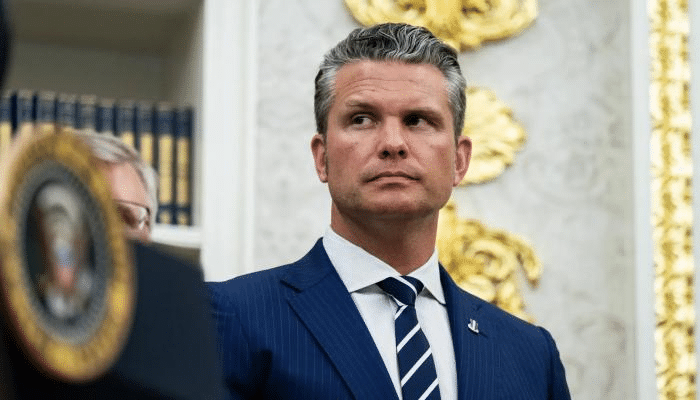
U.S. Defense Secretary Pete Hegseth met with Ecuadorian President Daniel Noboa on Thursday to discuss strengthening cooperation against drug-trafficking organizations and what Washington describes as “narco-terrorist networks,” as part of a tour of U.S. allies across Latin America.
Noboa has received strong backing from U.S. President Donald Trump for his campaign against cocaine-trafficking gangs, which have plunged Ecuador into a prolonged security crisis.
During the meeting in Quito, Hegseth and Noboa discussed expanding cooperation on border security to restrict the movement of criminal networks, particularly those operating along Ecuador’s border with Colombia.
The talks also covered efforts to combat illegal mining, with illicit gold production increasingly emerging as a major source of revenue for criminal organizations alongside drug trafficking.
Hegseth’s Latin American Tour
Ecuador was the third stop on Hegseth’s four-stage tour of Latin America. He visited Venezuela and Colombia on Wednesday before traveling to Quito on Thursday, with Honduras scheduled as his final destination.
The visit marks Hegseth’s first official trip to South America and comes amid an expanded U.S. focus on security cooperation in the region.
His diplomatic outreach follows a period of political controversy in Washington, where he narrowly avoided impeachment proceedings over the war on Iran and U.S. strikes against alleged drug-trafficking vessels in Latin American waters, which reportedly killed more than 200 people.
Ecuador is among more than a dozen Latin American countries, including Colombia and Honduras, that have joined Trump’s “Shield of the Americas” military and political alliance.
U.S. Military Cooperation Expands in the Region
Hegseth began his tour with an unexpected visit to Venezuela, where U.S. forces toppled socialist President Nicolas Maduro in a January 3 operation that reportedly killed more than 100 people in Caracas.
During a meeting with interim President Delcy Rodriguez, Hegseth pledged to pursue drug traffickers, a message he reiterated during his subsequent visit to Colombia.
In Colombia, Hegseth oversaw the delivery of a C-130 Hercules military transport aircraft. The country remains the world’s largest cocaine producer, while Ecuador is considered the region’s leading exporter of the drug.
On Thursday evening, Hegseth arrived in Honduras for talks with President Nasry Asfura, who was elected last year with support from Trump. A U.S. official said the two sides signed agreements covering cyber defense and national defense, without providing further details.
Human Rights Concerns Over Security Operations
Despite Washington’s support for Noboa’s crackdown on criminal gangs, human rights organizations have raised concerns about alleged widespread abuses by Ecuadorian security forces.
Reports have also pointed to an increased U.S. military presence in Ecuador, where voters rejected a proposal last year to lift the constitutional ban on foreign military bases.
At least 20 U.S. military flights have reportedly landed at a remote base on Ecuador’s Pacific coast in recent months. The aircraft included C-130 Hercules and C-17 Globemaster transport planes, V-22 Osprey tiltrotor aircraft, and Black Hawk helicopters.
Noboa has denied that the United States maintains a military base in Ecuador, saying American military personnel are involved only in temporary activities.